
When starting a commercial construction project, one of the biggest choices you will make is how the project will be delivered. Asking if Design-Build or Traditional Construction is “better” does not have one simple answer. The right option depends on your project goals, limits, and what matters most to you.
Each method has clear pros and cons that can affect your schedule, budget, quality, responsibility, and risk. Knowing the basic differences early helps owners planning offices, retail spaces, or major renovations-well before signing contracts or beginning design.
For example, in dense cities, dealing with strict rules-such as facade inspection and repair requirements like New York City’s Local Law 11-often works better when teams can plan and respond together. Bringing in Local Law 11 Experts early, no matter which method you choose, can prevent major problems and extra costs later.
What Is the Difference Between Design-Build and Traditional Construction?
At a basic level, Design-Build and Traditional Construction use different setups for how design and construction are planned and carried out. This choice can matter more than picking finishes or layouts because it shapes how decisions are made, who takes on risk, and how steady the final result is likely to be.
What Is Traditional Construction (Design-Bid-Build)?
Traditional construction, often called Design-Bid-Build (DBB), has been used for many years. It follows a step-by-step process where each phase must finish before the next one starts. In this model, the owner often serves as the main link between the design team and the construction team, since they are hired under separate contracts.
This method keeps responsibilities clearly separated: the architect (or designer) completes detailed drawings and specifications first. After the design is finished, the project goes out to bid, and contractors compete to build what is shown in the documents. This “handoff” from design to construction can create certain benefits, but it can also lead to gaps between design intent and what is practical in the field.
What Is Design-Build Construction?
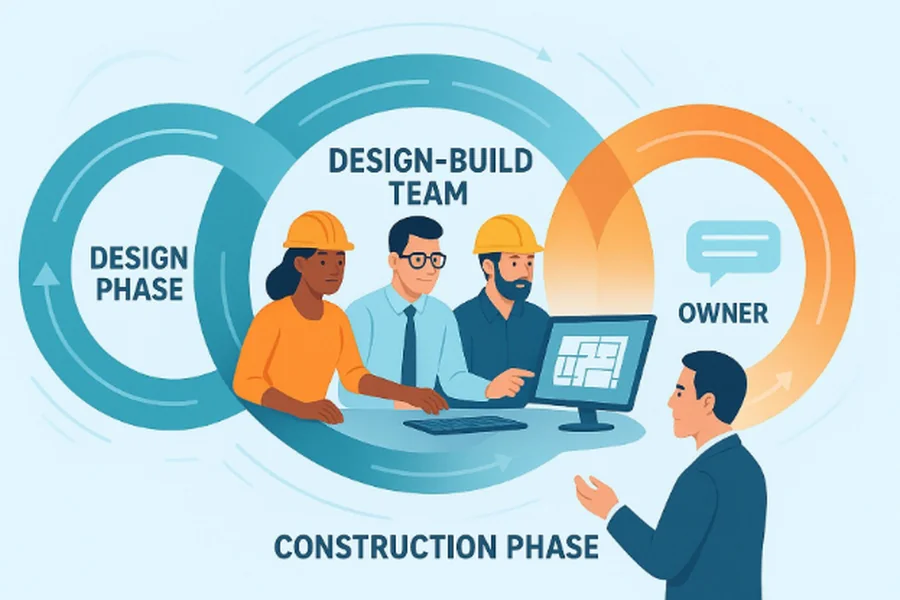
Design-Build (DB) combines design and construction under one contract, with one main party in charge-often called the Design-Builder. With this setup, designers and builders work together from the start, which can create a smoother process and often a faster schedule.
Instead of separating design and construction into strict phases, Design-Build allows them to overlap. This teamwork can reduce late changes and long review cycles. Design-Build used to be seen as an “alternative,” but it is now becoming more common and is expected to be used in a large share of projects by 2026.
How Does the Project Delivery Process Work in Each Method?
The day-to-day flow of a project looks different in each method, starting from early planning and ending with closeout.
Traditional Construction Step-by-Step Process
In Traditional (Design-Bid-Build), the project usually moves in a straight line. First, the owner hires an architect or design team to produce full drawings and specifications. Since the construction team is not involved during design, the owner can closely guide the design process, which can be helpful for complex commercial spaces like multi-tenant offices or healthcare projects with strict standards.
Once design is complete, the owner sends the documents to multiple general contractors for pricing. Contractors submit bids based on the completed plans, and the owner typically selects the most competitive bid.
A common challenge happens when bids come back higher than expected. If that occurs, the owner may need to revise the design and bid again, which can add time and cost. Construction begins only after a contractor is chosen and a separate construction contract is signed.
Design-Build Step-by-Step Process
Design-Build begins with the owner choosing a Design-Build team. This includes reviewing qualifications, checking experience, and confirming that the team can meet the owner’s needs and budget. After selection, the owner signs one contract that covers both design and construction, giving the project a single main point of contact.
During pre-construction, the Design-Build team gathers information about what the owner wants, spots likely challenges, builds a budget, and sets the schedule and performance goals. Then the design work starts, with the team working closely with the owner to develop plans that balance function, appearance, and cost at the same time.
Construction can start while parts of the design are still being finished, which can shorten the overall schedule. At the end, the team completes closeout tasks, confirms deliverables, and provides required documents and paperwork.
Roles and Responsibilities in Each Model
With the traditional method, the owner often becomes the main coordinator between separate design and construction contracts. Accountability is clearer on paper: the architect owns the design, and the contractor owns the construction work. However, the owner has more work managing communication, handling disputes, and reducing risk when the design and construction teams do not agree.
With Design-Build, responsibility is concentrated. The Design-Builder manages the project from early design through final construction. This single point of responsibility simplifies communication and reduces conflicts between designer and builder. The owner typically focuses more on approving goals, design direction, budget targets, and major milestones, while the Design-Build team manages the internal coordination.
Key Differences Between Design-Build and Traditional Construction for Commercial Projects
Choosing one method over the other can change how fast the project moves, how costs are handled, and how risk is shared.
Project Timeline: Integrated vs. Sequential Approach
Schedules are often very different. Traditional construction follows the sequence (design → bid → build), which tends to take longer overall. If something slows down in design, bidding, or construction, the whole schedule shifts. This can be a problem for commercial owners who need to open quickly or meet fixed move-in dates.
Design-Build allows design and construction to overlap. Work in the field can start before every drawing is fully complete. This “fast-track” setup can help businesses open retail locations sooner, reduce downtime for office renovations, or meet deadlines for warehouses and industrial buildings.
Cost Control and Budget Predictability
Traditional construction often uses competitive bidding, which can produce a lower starting price. However, early budget control can be weaker because the contractor is not part of early design decisions. If designs are completed without input on buildability, costs can rise later. Change orders, redesigns, and re-bids can push the final cost higher than expected. Many owners do not see a truly reliable construction cost until late in the design process, after bids come back.
Design-Build brings construction input into the process early. That makes it easier to track the budget during design, find cost-saving options, and pick materials and systems with real pricing in mind. The first estimate may not always be the lowest, but the final cost is often more predictable, with fewer surprise changes and fewer major change orders.
Risk Allocation and Management
Risk is handled differently. In traditional construction, the owner often carries more risk for coordination issues, design errors, and cost increases. Because the designer and builder are separate, the owner can end up between them when disagreements happen.
In Design-Build, the Design-Builder takes on much of the risk for both design and construction. With one responsible party, accountability is clearer, and many coordination problems are handled inside the team instead of being pushed back to the owner.
Communication and Decision-Making
Traditional construction can create communication gaps because architects, engineers, and contractors work under separate contracts and often in separate phases. This can lead to misunderstandings, missed buildability issues, and delays during handoffs. The owner often becomes the go-between, which can slow decisions and add stress.
Design-Build supports direct communication because the team works together from day one. Designers and builders share information and solve problems as one group, which can reduce rework and speed up decisions without constant formal handoffs.
Quality Control and Innovation
In traditional construction, the design team may create details that are harder or more expensive to build, which can lead to changes later. Quality control often focuses on whether the contractor built exactly what the drawings show.
Design-Build can support more practical design choices because builders give input early on materials, methods, and sustainability options. This can lead to smarter solutions and fewer late-stage design changes. Since one party is responsible for both design and construction, there can be a stronger push for consistent quality from start to finish.
What Are the Advantages and Disadvantages of Traditional Construction?
Even though Design-Build is becoming more popular, traditional delivery still makes sense for certain commercial projects and certain owners.
Advantages of Traditional Construction
A major benefit of Traditional Construction is strong owner involvement and direct control of the design. Owners can work closely with the architect and engineers to finalize the design before any contractor is involved, which is helpful when the project needs detailed customization or a specialized architectural approach.
Another benefit is competitive bidding. After the design is complete, several contractors can bid on the same set of documents. This allows the owner to compare prices and select a contractor based on market competition. Also, because responsibilities are separated, it can be easier to sort out whether an issue is a design problem or a construction problem.
This approach is also familiar and widely used, especially for public projects where competitive bidding is often required. Nova Construction Services has the experience to deliver results under any project delivery method, including traditional construction.
Risks and Disadvantages of Traditional Construction
Traditional Construction also has downsides. Because it is a step-by-step process, the overall schedule can be longer. Delays in design, bidding, or construction usually push everything back.
Cost overruns can also be more common. Without contractor input during design, choices can be made that later turn out to be expensive or difficult to build. When those issues show up on-site, the result is often change orders and redesigns that increase costs. Since design and construction teams work separately, misalignment and communication issues can occur, and the owner may need to spend a lot of time coordinating and settling disputes.
Another challenge is budget uncertainty: owners may not know the true construction cost until bids come in, and if bids are too high, redesign and re-bidding can add more expense.
What Are the Advantages and Disadvantages of Design-Build for Commercial Projects?
Design-Build offers a different setup that often fits modern commercial projects that value speed and clearer budgeting.
Advantages of Design-Build
A main advantage of Design-Build is having one party accountable for both design and construction. With one contract, communication is simpler, decision-making is more connected, and conflicts between designer and builder tend to drop. Projects can often start sooner and finish faster because design and construction can overlap, which helps businesses with tight deadlines.
Cost management is also stronger early on. With the contractor involved during design, the team can track costs in real time, suggest cost-saving options, and choose materials and systems with the budget in mind. This often reduces cost surprises later. Design-Build also supports teamwork and practical problem-solving, since architects, engineers, and builders work together. Owner risk can be lower as well, because the Design-Builder takes responsibility for both design and construction outcomes.
Risks and Disadvantages of Design-Build
Design-Build is not perfect for every owner. Some owners feel they have less direct control over small design decisions, since the Design-Builder is balancing cost, schedule, and buildability. This method relies on trust and clear communication, since the owner is depending on one team for both design and construction.
Another concern is pricing. Since there is no separate bidding phase after design is complete, owners may see less open competition at the main contractor level (even though subcontractors may still be bid). In some cases, that can mean higher costs.
There can also be a concern about priorities: combining design and construction may lead some teams to favor build speed or cost savings over certain design choices. Finally, once the project is underway, major changes can be harder to make without affecting budget, schedule, or quality.
Common Misconceptions About Design-Build and Traditional Construction
Choosing between these methods often means sorting through a few common myths. One is that traditional construction is always cheaper because of competitive bidding. While the first bids may look lower, the step-by-step process can lead to delays, change orders, and added costs that raise the final price.
Design-Build often provides a steadier final cost because budget checks happen earlier and coordination is tighter, even if the first estimate is not the lowest.
Another myth is that traditional construction gives owners more control because they manage separate contracts. In real life, that “control” can turn into extra workload, with the owner acting as referee between separate parties. Design-Build shifts the owner’s role from managing multiple vendors to managing results-approving design direction, budgets, and milestones while the team handles coordination.
Some people also think Design-Build is new or untested. It has been used for a very long time, and its growing use today shows it works for many project types in both private and public settings.
Practical Examples: How the Choice Impacts Commercial Projects
To understand how these delivery methods play out, it helps to picture how they work on real commercial projects.
Case Study: Office Building Project
Think of a new office building in a busy city. The project has complex layouts, specialized mechanical, electrical, and plumbing (MEP) systems, and strict code requirements. With the traditional Design-Bid-Build method, the architect completes the full design, including detailed MEP plans, and then contractors bid. If the contractor later finds that the MEP design clashes with structural elements, or that a key part is hard to get, the project can face redesigns, change orders, and delays. The owner may have to manage back-and-forth between the architect and contractor and carry the coordination risk.
With Design-Build, MEP engineers and the construction team are part of early planning. They can spot clashes earlier, recommend cost-saving MEP options, and check material availability while the design is still being developed. This teamwork can also support smoother permitting and fewer on-site surprises. It can also make it easier to coordinate facade needs-such as bringing in Local Law 11 Experts-without creating a separate, disconnected process.
Cost and Schedule Outcomes
In the traditional office example, the step-by-step structure and communication gaps can lead to a project finishing months late and over budget, especially if change orders stack up. Each delay can mean lost income for the business waiting to move in, plus extra holding costs.
With Design-Build, overlapping phases and early problem-solving can shorten the schedule. Cost discussions happen earlier, which can reduce surprise expenses. Even if the starting price is not the lowest, the final cost is often easier to predict and less likely to jump due to late design conflicts or field conditions. Early alignment can reduce redesign loops and help the project reach occupancy with fewer disruptions.
When to Choose Design-Build vs. Traditional Construction for Your Commercial Project
The best option depends on your project type and what your organization values most.
When Is Traditional Construction Preferable?
Traditional construction often works best when the project scope is clear early and is not expected to change much. It is also common for public sector work where formal competitive bidding is required. Projects that need specialized architecture, where the owner wants independent design development and close oversight, may also fit well with this approach.
If the owner has a strong in-house team that can manage multiple contracts, or if speed is less important than formal procurement and maximum design control, traditional delivery can still be a good match.
When Is Design-Build the Better Choice?
Design-Build often works well when finishing faster is a top goal-such as retail spaces that need to open quickly or industrial sites with firm operating deadlines. It is also helpful when you need early, accurate cost guidance and want stronger budget predictability from the start. For complex projects with heavy MEP work, upgrades in occupied buildings, or multi-site rollouts, the integrated team approach can reduce coordination issues and speed communication.
Design-Build can also be a strong fit when you want a cooperative process that supports problem-solving as the project moves forward. In areas with special code requirements or environmental factors, having design and construction experts working together can make compliance and planning easier.
How to Decide Which Method Is Right for Your Commercial Construction Project
Picking the right method means looking closely at your project needs. Every project is different, and the best fit depends on your goals and limits.
Project Size, Complexity, and Owner Priorities
Start with the size and difficulty of your project. Commercial buildings often include complex layouts, specialized mechanical, electrical, and plumbing (MEP) systems, strict local codes, and sometimes green building targets like LEED. The more complex the work is, the more helpful a combined team approach can be.
Next, define your priorities. Is speed the most important factor? Do you need tight budget predictability? Or is detailed creative control over the design your main goal? Your answers will point strongly to the best delivery method.
Questions to Ask Before Deciding
Before choosing a delivery method, ask key questions like these:
- How important is opening quickly or keeping the schedule as short as possible for your business?
- How much hands-on control do you want over design details versus focusing on results and approvals?
- How comfortable are you with one party being responsible for both design and construction?
- How much budget and schedule movement can your organization handle?
- Do you have the staff and experience to manage separate design and construction teams and handle disputes if they arise?
Your answers will help you match your goals to the method that best supports a successful commercial project.
Conclusion
The choice between Design-Build and Traditional Construction is less about which one is “best” in general and more about how each method spreads out cost, risk, and control. Traditional construction separates design and construction into clear phases, while Design-Build combines them into one connected process.
For owners who want faster schedules, clearer responsibility, and smoother coordination in today’s commercial construction market, Design-Build often fits well.
That said, traditional delivery can still work very well for projects with fixed requirements or public rules that require competitive bidding. The main step is to understand how each method works, how it assigns risk and control, and how that lines up with your project scope and goals.
Choosing the right method is a business decision that affects more than the final look of the building-it affects how smoothly and efficiently the project gets delivered and how well it supports your operations afterward.

Nike is the founder and editor at nameshype.com. He is graduated in English language and love to write and share information online.
Therefore he has created this unique community to give millions of people all over the world with unique, funny, cute and creative name ideas.